Org clarity and control
Get control over your complex Salesforce org
Don’t let your complex Salesforce orgs stall delivery of your next project. When you understand your org, you can make changes safely — and ship at the pace the business needs.


You can’t scale AI in an org you don't fully understand.
In a complex org, every change takes longer to scope, deployments carry unknown risk, and teams lose hours diagnosing issues. These orgs can’t handle the increased volume of AI-generated change, and things slow down when you want them to speed up.

Know the impact of every Salesforce change before you make it
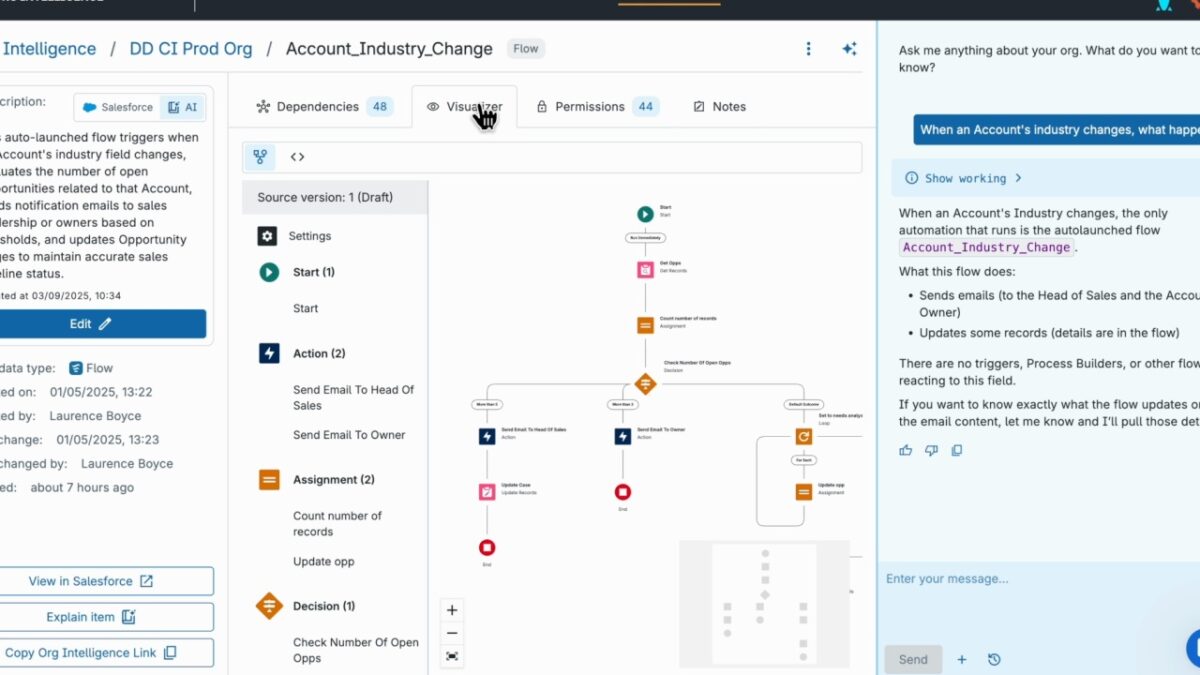
See your metadata, dependencies, and technical debt clearly, with AI-powered intelligence surfacing downstream impact in seconds.
Trust that every change meets your standards
Enforce quality standards across human- and AI-generated changes with automated code reviews, blocking bad code, and stopping tech debt compounding.
Get a clear picture of issues in your org
Proactively monitor your entire org, so you can catch and fix issues fast, understand causation, and prioritize fixes based on severity.
Test at the pace your team ships
Avoid testing bottlenecks as change volume grows. Bake quality into deployments with automated testing, so speed never comes at the cost of stability.
Move faster with shared org knowledge
Give your team a living, searchable source of truth for your org, so new joiners ramp faster, senior people aren’t a bottleneck, and critical knowledge remains when people leave.
We have full visibility into what’s going on in our org, so we can reduce downtime and tech debt.
Marko Self
Salesforce Development Manager, Ping Identity

Is your org ready for what’s next?
Whether you’re ramping AI workflows, merging orgs, or rolling out a new cloud, your org needs to be ready for it. º£½ÇÌìÑÄÉçÇø gives you the control and confidence to get there.

Faster delivery, without the risk
When your team understands your org, every change and every triage takes half the time. Spend less time on impact analysis and more time shipping.

Security you can stand behind
An org full of blind spots is at risk. Know what's exposed, what each change might affect, and stay ahead of incidents before they strike.

An org that scales with your ambitions
Complex, tangled orgs are hard to scale. Regain control so you can deliver business initiatives at pace, without starting from scratch.
Deliver with confidence, every time
When you deeply understand your org, you can anticipate problems and act with confidence. Find out how º£½ÇÌìÑÄÉçÇø gives you a connected picture of your entire org, and the tools to act.
Further resources



FAQs
What does a complex or poorly understood Salesforce org actually look like?
A complex org is often the result of poor documentation and lack of standards over a long period of time. Undocumented custom objects have accumulated over time, custom code has been written by people who have long since left, user permissions are inconsistently applied and unused fields clutter the data model. As a result, Salesforce admins and developers spend hours figuring out validation rule conflicts and manual impact analysis before making a change for fear of breaking something.
Without guardrails and quality standardisation, every new commit risks adding to the mess rather than improving it. And without monitoring or observability, errors and failures go undetected in the background, only surfacing when something breaks for a user or business processes stop entirely.
This leads to slow development cycles, a lack of confidence, and risk. For teams scaling their Salesforce platform, or preparing for a major implementation like an org merge or new cloud rollout, this kind of technical complexity can cause serious problems.
How quickly can teams get visibility into their org with º£½ÇÌìÑÄÉçÇø?
Most teams get a meaningful picture of their org the first time they use º£½ÇÌìÑÄÉçÇø/ º£½ÇÌìÑÄÉçÇø connects to your Salesforce environment and immediately begins analysing your metadata, dependencies, and custom code, surfacing potential issues ranked by severity, without requiring weeks of manual setup or a professional services engagement. There’s no complex implementation process: º£½ÇÌìÑÄÉçÇø is built to integrate with the tools and systems your team already uses, so you can go from connection to insight to action quickly.Â
What is technical debt in Salesforce, and how does it affect delivery?
Technical debt in Salesforce is what happens when quick fixes made today create bigger problems tomorrow. Every time a field, Flow, validation rule, or automation is added without considering how it fits the bigger picture, it becomes harder to change things without breaking something else.
It shows up across several categories: Apex code that hits governor limits under real data volumes, excessive custom fields with hundreds of dependencies, overlapping automations built by different teams over the years, and critical business logic that lives in one person’s head rather than in documentation. Left unaddressed, it creates a scalability wall, where even straightforward changes require weeks of investigation, and a growing share of the technology budget gets redirected away from new initiatives toward managing the consequences of past decisions.
The result is deployment time inflation, with routine changes becoming slow, risky, and expensive. Understanding and actively managing technical debt is what separates teams that can deliver at pace from teams that are permanently firefighting.
What is Salesforce org health and why does it matter?
Salesforce org health refers to the overall state of your Salesforce environment: how well-configured, secure, and maintainable it is relative to your business goals. An unhealthy org accumulates technical debt over time due to over-engineered custom development, outdated configuration, undocumented business processes, and data quality issues that erode trust in the system. Poor org health directly affects productivity, because users work around a system they don’t trust, and teams can’t deliver at the pace the business needs. A healthy org, by contrast, supports confident delivery, scales with your organisation, and positions you to take advantage of new capabilities across the Salesforce ecosystem, including AI.
What is a Salesforce org health check, and how is it different from a manual org assessment?
A Salesforce org health check — sometimes called a Salesforce org assessment — is a systematic review of your org’s configuration, custom code, security posture, and performance against best practices. Traditionally this was a manual process performed by a consultant or senior Salesforce admin who would spend days or weeks reviewing the setup of a Salesforce instance, identifying potential issues, and producing a report. The problem with manual org assessment is that it’s a point-in-time snapshot, and by the time it’s complete, the org has moved on.
Modern tooling like º£½ÇÌìÑÄÉçÇø makes it possible to run a continuous health check: automatically surfacing security risks, flagging performance issues, identifying unused fields, and ranking problems by severity so teams can prioritise and fix vulnerabilities. This gives organisations an objective, up-to-date picture of their Salesforce health, and a starting point for optimization.
Find out how º£½ÇÌìÑÄÉçÇø can help
Book a tailored demo and discover how º£½ÇÌìÑÄÉçÇø could work for your team. Just let us know your current setup and challenges, and we'll take it from there.


